
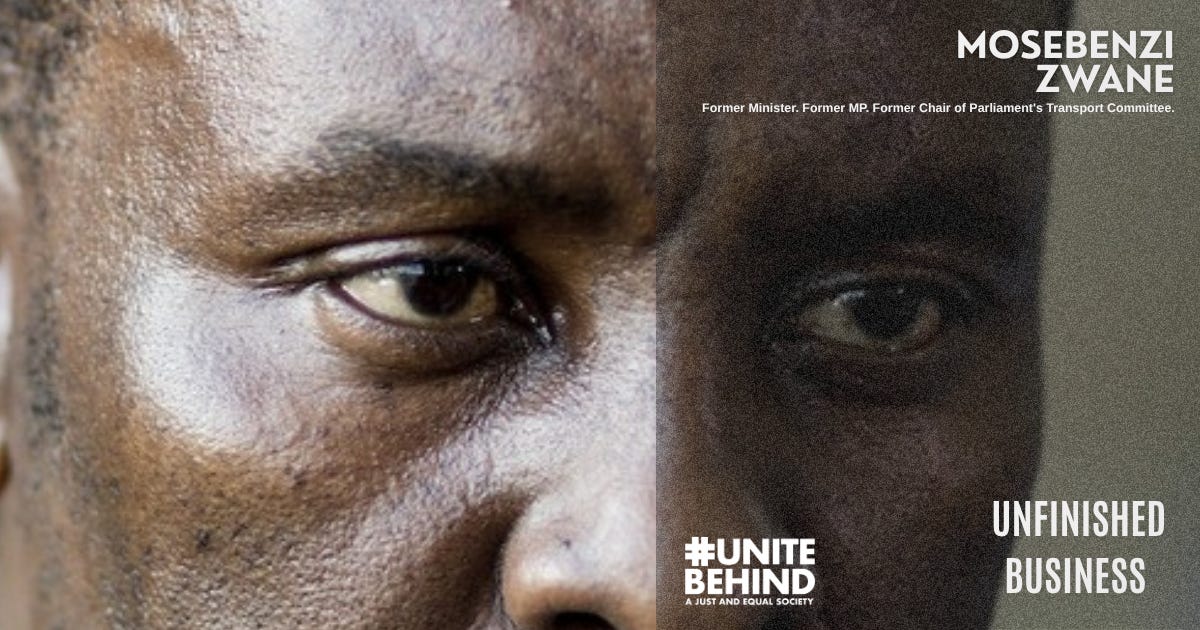
Original Sin
This story is about Mosebenzi Zwane, the former Minister and Member of Parliament who was implicated in corruption during his time at Eskom, resulting in the loss of billions of rands for the ordinary people and our economy at large.It is also about his failure to hold PRASA executives to account – while our rail systems were being looted and destroyed.
It is about a Parliament which failed to hold both him and the 5 other members of parliament to account for their actions, despite the thousands of documents of evidence, and the cries of the public.
Finally, this story is about the continuing fight of activists, civil society and ordinary people to create a state that is free from corruption, a state that is led by communities that truly works for the poor and working classes.
Who is Mosebenzi Zwane?
Mosebenzi Zwane is a senior politician, who has held some of the most important positions in government. He was the Minister of Mineral and Petroleum Resources from September 2015 to February 2018. Later on, he served as the Chairperson of the Portfolio Committee on Transport from July 2019 to March 2023. He had been a member of Parliament from 2015 until 2024 – a total of 9 years.
What did he do?
The Gupta-linked Estina Dairy Farm Scandal
Before he ever got to work in the National government, Zwane’s career began in the Free State. While being MEC for Agriculture in the Free State, he was implicated in the corrupt Vrede dairy farm scandal – which was later found to be a front for Gupta-linked state capture. It was described by the Daily Maverick as the original sin of state capture.
Eskom
While being the Minister of Mineral Resources from 2015-2018, he was implicated in severe corruption at Eskom alongside the infamous Gupta family.
The State Capture Commission recommended that Zwane be criminally prosecuted for his conduct as Minister of Mineral Resources and investigated over the Vrede dairy farm project. The Commission found that Zwane and former ANC Secretary-General Ace Magashule should be sued to recover R280 million lost through the alleged Vrede scam.
Despite these findings, he was appointed Chair of the Parliament’s Portfolio Committee on Transport, which is constitutionally responsible for parliamentary oversight of PRASA and the Department of Transport. Although he was not implicated in corruption at PRASA, during his time as Chairperson, he failed to investigate or act on the corruption at PRASA, despite thousands of documents of evidence and the repeated cries of commuters, activists, and the public
Parliament’s New Rules: #UniteBehind takes PARLIAMENT to court!
Something had to be done. In September 2022, #UniteBehind submitted complaints against six members of parliament – which included Mr Zwane. In our complaint on Mr Zwane we wrote:
‘through his acts and omissions failed to prevent injury, loss of life, the destruction of infrastructure, the wholesale theft of assets, corruption worth billions of Rands and state capture’
However, Parliament did not act. After months of silence, we decided to take Parliament’s Ethics Committee to court over its lack of action. As we had mentioned previously, the complaints against Dipuo Peters and Joe Maswanganyi were upheld – both were suspended from parliament. However, the complaints against Zwane were dismissed, with seemingly no investigation of the evidence provided. #UniteBehind challenged the decision to dismiss the complaints against Zwane and two others in court.
Shifting the goalposts: Parliament’s new rules
Seemingly in response to this, in the middle of our legal challenge, Parliament changed its Code of Ethical Conduct in 2024, removing the rule that required misconduct investigations to continue even if a member had resigned or left their position. This effectively allows those responsible for the loss of billions in the economy and the destruction of critical infrastructure that we all depend on – to walk away from any accountability.
In response to this, we had to change our court papers to not only challenge the corrupt, but the new rules that protect them.
The Western Cape High Court is expected to deliver a judgement this year on this matter. This is one of the most important legal cases in post-apartheid South Africa. A victory in the courts means for us means one step closer to getting the corrupt out of power, and moving towards a just and equal society where communities hold power – not politicians.
A recovering rail system
Last year PRASA recorded 77 million passenger trips – almost double the previous year’s 39.4 million. 35 of 40 service lines have been restored, 268 new Electric Multiple Unit trains accepted, and a clean audit achieved for the first time in years. These are genuine improvements. But this 77 million trips is just 15% of the 516 million recorded in 2014/15 when the service was running at its peak. The damage done during the state capture years – during which Zwane chaired the oversight committee – will take decades and trillions of rands to repair.
The National Rail Master Plan
In April 2026, Cabinet approved the Draft National Rail Master Plan (NRMP): South Africa’s first long-term strategic framework for rail in decades. Transport Minister Barbara Creecy released it for public consultation on 23 April 2026. The plan envisions a R2 trillion investment to reposition rail as the backbone of South Africa’s logistics and transport system by 2050.
The National Rail Master Plan is explicit that suburban rail usage ‘remains well below historic levels’.
What does the NRMP reveal about the cost of state capture?
- The current annual losses to South Africa’s economy due to its rail challenges amount to R276 billion or 3.6% of the GDP.
- Suburban rail usage remains below levels recorded since 1997 – a generation of lost progress
The NRMP makes the need for accountability more urgent. If tax-payers are now asked to invest R2 trillion to repair rail infrastructure – we must ensure that our rail system does not get destroyed again and that those who are responsible for the destruction of the past are held accountable.
The hidden costs of corruption
The scale of the destruction of our State Entities like PRASA and Eskom is difficult to understand immediately. Although the theft and looting began years ago, we are still paying the price today.
The City of Cape Town estimated in 2019 that R2.8 billion was lost annually due to the transport crisis through lost productivity and road congestion.
At the current National Minimum Wage of R30.23/hour (March 2026), the extra R31.25/day a commuter pays for taxis instead of trains exceeds one full hour of pay. This means that roughly 13% of a standard day’s earnings are wiped out before work even begins. These are the hidden costs of corruption.
We need Community Power to #FixOurTrains
The already-expensive cost of transportation has now been made worse by the regional conflict in the Middle East. From 1 April 2026, taxi fares rose again in direct response to the fuel spike. This will happen again this month. Now more than ever, we need safe, efficient and affordable public transport. A commuter-led rail service is the best answer.
However, with corruption at PRASA still being the order of the day, it is time for us as communities to step up. We need a commuter-led service. We need state entities that are free of corruption. We need to ensure that the corrupt never wield power again. It is only us — the commuters, workers, students and broader public — who can make it happen.