
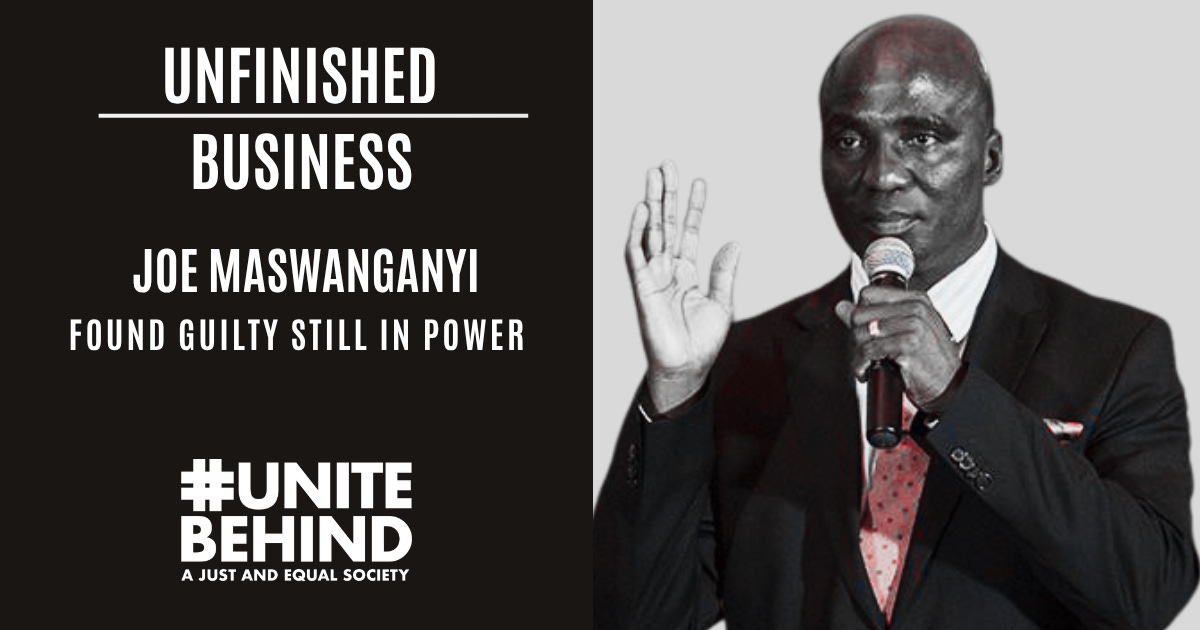
Part Two: Joe Maswanganyi – Unaccountable
It is easy to treat corruption as something abstract – something that happens in board rooms that we hear about in the news and media, far removed from our daily life. But the consequences are in fact direct.
Let’s take PRASA for example.
In the 2010’s PRASA was just one of the state-owned enterprises that were looted, mismanaged and destroyed from the inside out by a group of political elites, business people and criminals.
When corruption hollows out a state institution, the people who feel it first and hardest are not those responsible – but those who depend on the very services that the state provides.
The Zondo Commission report estimated that BILLIONS of Rands were lost during the so-called ‘State Capture’ era.
This had – and still has – not only an effect on commuters, who had to spend at least 3 times more on transport and are now slowly returning to a recovering rail system, but it cost the country as a whole. The billions that were stolen and misused at PRASA and other state organs, caused damage to our economy, meaning that the state had less and less money as years went on. Money that could have gone to the expansion of much needed basic services and infrastructure that we all use – such as schools, hospitals, roads and railways – was instead lining the pockets of the politically corrupt and the business elites.
Where do we draw the line?
WHAT DID JOE MASWANGANYI DO AS MINISTER OF TRANSPORT
The Honourable Joe Maswanganyi was the minister of transport from March 2017 to February 2018.
Through investigations from Thuli Madonsela’s Derailed Report, the Zondo Commission, as well as #UniteBehind’s own research and leaked whistleblower reports, it is alleged that Hon. Maswanganyi:
- Actively undermined PRASA’s efforts to combat corruption during his tenure as Minister of Transport from March 2017 to February 2018.
- Never met with the Molefe Board and weakened the Board by not appointing members to it so that it became inquorate and unable to make decisions.
To quote from the State Capture Report:
- He, “in effect rendered it unworkable. What is however more worrisome … [is that] he said that it was Parliament that had decided to dissolve the Board and a ‘Minister cannot go against a decision’ taken by Parliament! On that score, Mr Maswanganyi is simply wrong. As powerful as Parliament is, the power to dismiss the Board lies with the Minister. It is considered that there should be serious reservations about appointing as a Minister [or indeed, a Chairperson of a vital Portfolio Committee] a person who has so limited an understanding of who holds the reins of power in respect of matters that fall within his Portfolio.”
Additionally:
- He failed to appoint a new Group CEO for three years, leaving the organisation without the leadership needed to make key decisions, destabilising PRASA’s management.
- He unlawfully appointed an interim board led by Justice Makhubele, who simultaneously held a judicial position – a direct violation of the Judicial Services Act. During her tenure, Makhubele attempted to settle corrupt contracts, blocked efforts to recover corrupt payments, and even suspended PRASA’s legal panel to obstruct corruption investigations.
- #UniteBehind filed complaints against her to the Chief Justice in 2019. In 2025 she was found guilty of Gross Misconduct and now may face impeachment proceedings.
- He failed to recover R79 million paid into ANC-linked accounts as part of the corrupt R3 billion Swifambo deal. He inherited and ignored a known corruption scandal involving purchased trains too tall to run on South Africa’s railways. Despite this being on record when he took office, Maswanganyi took no steps to investigate or recover the funds – continuing a pattern of deliberate inaction that the State Capture Report identified as the failure of the previous minister – Dipuo Peters.
What happened next?
After #UniteBehind had submitted complaints to Parliament over both Hon Maswanganyi (and 5 other MPs), Parliament’s Joint Committee on Ethics and Members’ Interests later found that Maswanganyi “failed to act… in accordance with the public trust placed in him”.
The committee recommended he be suspended from his seat in all parliamentary debates, sittings, and committee meetings from 10 October 2023 to 1 December 2023 – a period of less than two months. Critically, the Ethics Committee declined to investigate two of the three complaints against him: (1) his failure to act on the R79 million Swifambo payment to ANC-linked accounts, and (2) his unlawful attempt to negotiate the R57 billion Moloto Rail corridor deal with China.
He has continued to serve as a Member of Parliament and as Chairperson of Parliament’s Standing Committee on Finance since his suspension ended in December 2023 – a slap in the face to everyone who lives in South Africa.
Should We Allow Joe Maswanganyi to Still Serve in Government?
It is worth pausing on that. A man found to have failed the public trust, implicated in corruption at one of South Africa’s most important state-owned entities, now sits in oversight of the country’s finances.
We ask this question: how can we trust a man complicit in corruption to have oversight over treasury and state-owned entities?
Corruption affects us all. We are not outside observers. When we observe that society is unjust, we must remember: We are society. When we allow those implicated in serious wrongdoing to continue wielding power without consequence, it does not just fail the past, but it paves the way for the next act of corruption.
Maswanganyi received a two-month suspension. The commuters, workers, students and everyday people, received years of destruction. The gap between what was done and what we had to face as a result – is what this series is about.
Corruption and negligence at the top of public institutions always flow down towards ordinary people.The question is never whether the public will pay the price for the wrongdoing of those in power, but how much we will pay, and for how long.
When we allow politicians to rule over us – instead of alongside us – we create the pathway for our own destruction.We cannot build a just and equal society on corruption, exclusion, and unaccountable leadership. It is time to demand a society free from corruption. A society governed with communities, by communities, and in the interests of the people themselves.